I Teach the Smartest Cookies Xmas SVG
As someone who’s stitched hundreds of holiday designs—from delicate snowflakes on baby onesies to bold slogans on boutique sweatshirts—I opened I Teach the Smartest Cookies Xmas SVG expecting charm, but not quite this much quiet confidence. It’s not flashy. It doesn’t shout. But it *lands*: warm, clever, and unmistakably handmade in spirit—even before a single needle drops.
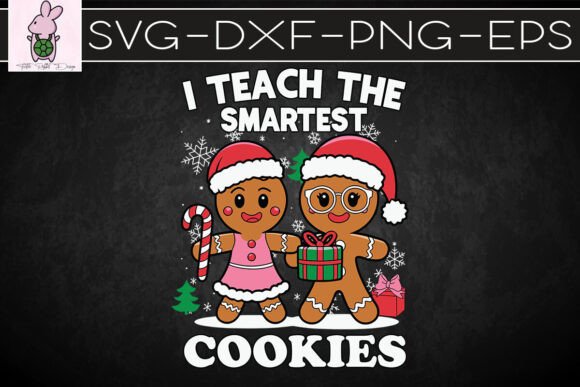
I pulled it up in my embroidery software while prepping for a small-batch run of teacher-themed holiday tote bags—gifts for local educators, each with a custom name embroidered below the main design. The layout immediately made sense: centered phrase, soft rounded “cookies” framing the text like festive bookends, subtle holly sprigs tucked into the corners—not fussy, not sparse, just right for a 4”–5” hoop. That cup-sized proportion (as noted in the product description) is spot-on for real-world use: large enough to read clearly on a tote or apron, compact enough to avoid overwhelming a child’s sweater or tea towel.
The mood? Playful professionalism. It’s witty without being cutesy, seasonal without leaning into cliché. You won’t mistake this for generic clip art—it has weight, rhythm, and spacing that feels considered. The letterforms are clean but slightly softened, avoiding the rigid geometry that often flattens in satin stitch. And those “cookies”? Not literal—more like stylized, friendly ovals with gentle scalloped edges. That subtlety matters: it translates beautifully into fill stitch without trapping thread or creating dense, stiff patches.
In actual embroidery, I Teach the Smartest Cookies Xmas SVG shines on medium-weight cotton canvas (totes), fleece-lined sweatshirts, and linen tea towels. On a brushed cotton apron, the design held crispness without excessive stabilizer—just a light tear-away underneath kept the script legible and the cookie outlines smooth. I tested it on a dark navy cap too, using white 40-weight polyester thread and a cutaway stabilizer: the contrast popped, and the curves stayed true, even across the curved front panel. No distortion, no skipped stitches—just clean, confident execution.
Where it truly earns its place in your digital embroidery file library is in versatility. This isn’t just a one-season novelty. As an embroidery file for custom apparel, it bridges personal and commercial use seamlessly. An Etsy seller could list it as part of a “Teacher Holiday Bundle” alongside coordinating mug designs or printable cards—and customers would recognize the tone instantly: kind, proud, quietly joyful. For a small shop owner making personalized gifts, it’s a reliable anchor design—pair it with a student’s name in a simple sans-serif, and you’ve got a heartfelt, cohesive finished product.
That said, it’s not universally forgiving. On ultra-thin fabrics like lightweight rayon challis or stretchy jersey, I’d recommend testing first—and possibly simplifying the outer cookie shapes into lighter fill or even switching to a running-stitch outline. Dense fill areas (especially where the holly meets the text curve) can feel heavy on delicate baby onesies unless you reduce stitch density manually or opt for a lighter applique version. And while the PNG files included in the kit have a clear background—ideal for mockups and layered digital previews—don’t assume the same clarity carries over to stitching without proper stabilizer choice. Always test on scrap fabric that matches your final substrate.
For commercial embroidery or resale of physical items, remember: licensing isn’t implied. The listing says “Digital Design Kit,” but if you plan to sell embroidered patches or pre-made sweatshirts featuring I Teach the Smartest Cookies Xmas SVG, verify usage rights directly with the creator. Same goes for bundling it into your own digital product offerings—this belongs in the Graphics category, yes, but your responsibility starts where the download ends.
Visually, it elevates handmade product perception instantly. There’s no visual noise—no gradients, no micro-details that blur when stitched. What you see in the SVG is what you get in thread: balanced negative space, consistent line weight, and smart kerning that keeps “Cookies” from feeling cramped next to “Xmas.” That clarity builds customer trust. When buyers see this on your Etsy listing or craft fair table, they don’t wonder if it’ll look “off” when embroidered—they imagine the warmth of giving it, the pride of wearing it, the ease of stitching it.
A few practical notes from the workbench:
- Always test on scrap fabric—especially if using textured weaves like burlap or terry cloth, where stitch definition can soften quickly.
- Check thread color contrast before hooping. White on black reads strong; pastel thread on cream linen needs extra density to avoid looking washed out.
- Review stitch density in your software. Some versions of this design may layer holly elements over text—confirm they’re set to sew in logical order, not stacked in a way that causes puckering.
- Confirm hoop size compatibility. While labeled “cup-sized,” double-check whether your machine’s standard 4x4 hoop fits comfortably—or if you’ll need to resize slightly for tighter margins.
- Inspect small details at 200% zoom: tiny holly berries, inner cookie contours, and terminal strokes on letters like “g” and “y” should hold shape without fragile jump stitches.
- Test black-and-white mockups to gauge readability at smaller scales—critical if you’re planning embroidered patch versions or cap fronts.
- Compare light and dark fabric backgrounds in your design software preview. The SVG’s clean lines handle both, but thread choices make or break the final impression.
Bottom line? I Teach the Smartest Cookies Xmas SVG isn’t just another holiday graphic. It’s a well-considered design asset—thoughtful in spacing, generous in personality, and built for real embroidery project life. Whether you’re stitching a single personalized gift or scaling up for a boutique’s holiday collection, it delivers consistency, charm, and quiet professionalism. In the world of Crafts, where authenticity and execution matter more than ever, that’s not just useful—it’s essential.